How we built a complete AI operating system that runs entirely on your hardware — no cloud, no subscriptions, and no data ever leaving your device.
You pay a monthly fee for access to someone else's models running in someone else's data centers. Your prompts, your voice, your documents, and your private thoughts are sent across the internet, stored, and used to train future versions of those models. If the company changes its terms, raises prices, or simply decides you are no longer a welcome customer, your access can be revoked on a Tuesday morning.
This is not intelligence you own. It is intelligence you lease.
Voical exists to change that.
We built a complete local AI operating system that runs entirely on your own Apple Silicon hardware. No cloud. No subscription. No data ever leaves your trusted devices unless you explicitly choose to open the bridge.
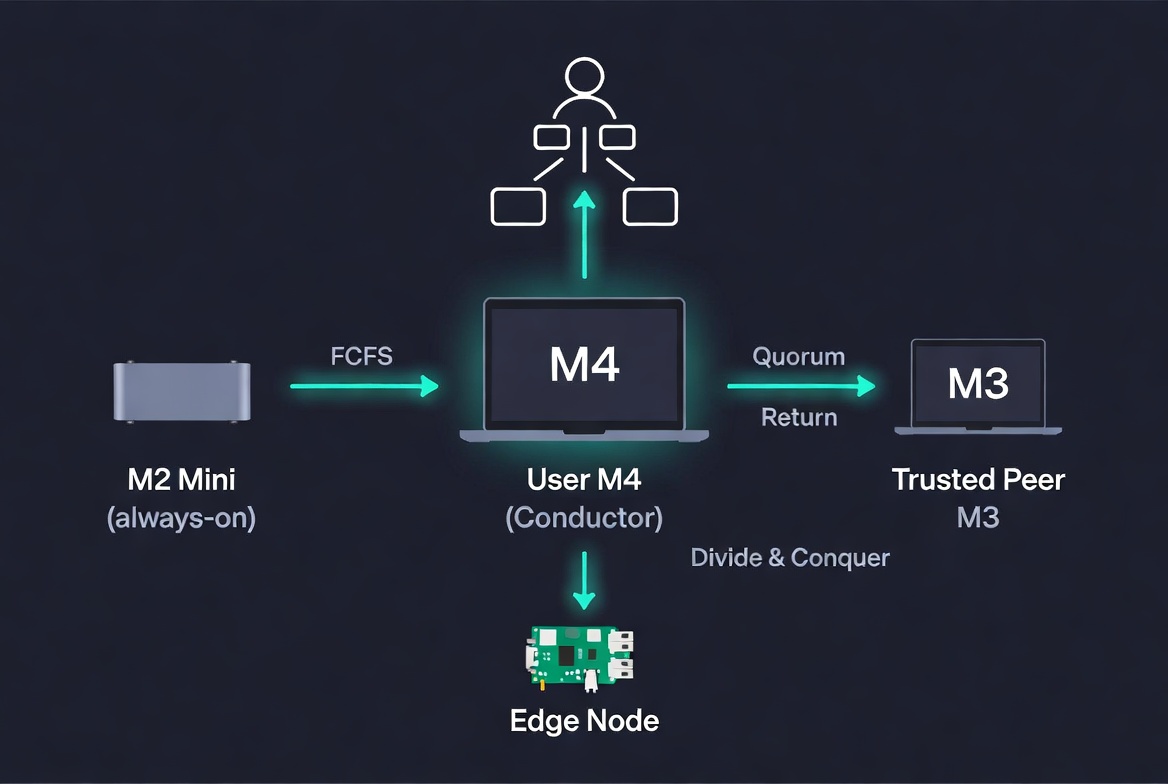
Thalamus Mesh turns your trusted hardware into a single distributed intelligence.
Everything is paid for once. Everything runs on your hardware. Everything belongs to you.
A git repository acts as the durable, conflict-tolerant message bus. All tasks, results, verdicts, chat messages, and memory anchors are stored as versioned Markdown files.
When devices are on the same Wi-Fi, real-time notifications dramatically reduce latency while content still flows through git.
When explicitly enabled, a lightweight WebSocket relay carries only task IDs and notifications — never content, never model output, never private data.
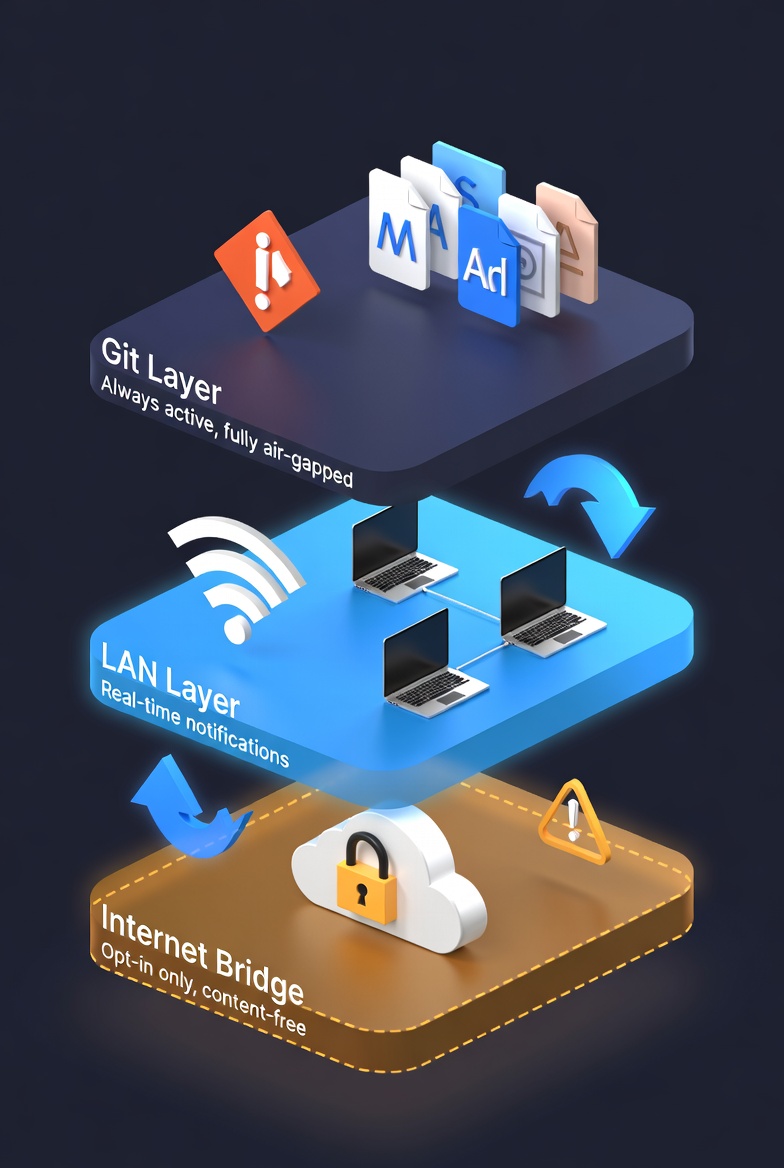
Each layer adds speed without changing protocol semantics. Remove the internet layer and the mesh continues to function perfectly.
This design means Voical works perfectly offline, becomes dramatically faster on LAN, and can optionally reach trusted peers across the internet without compromising the privacy model.
Voical solves this with a three-layer memory system:
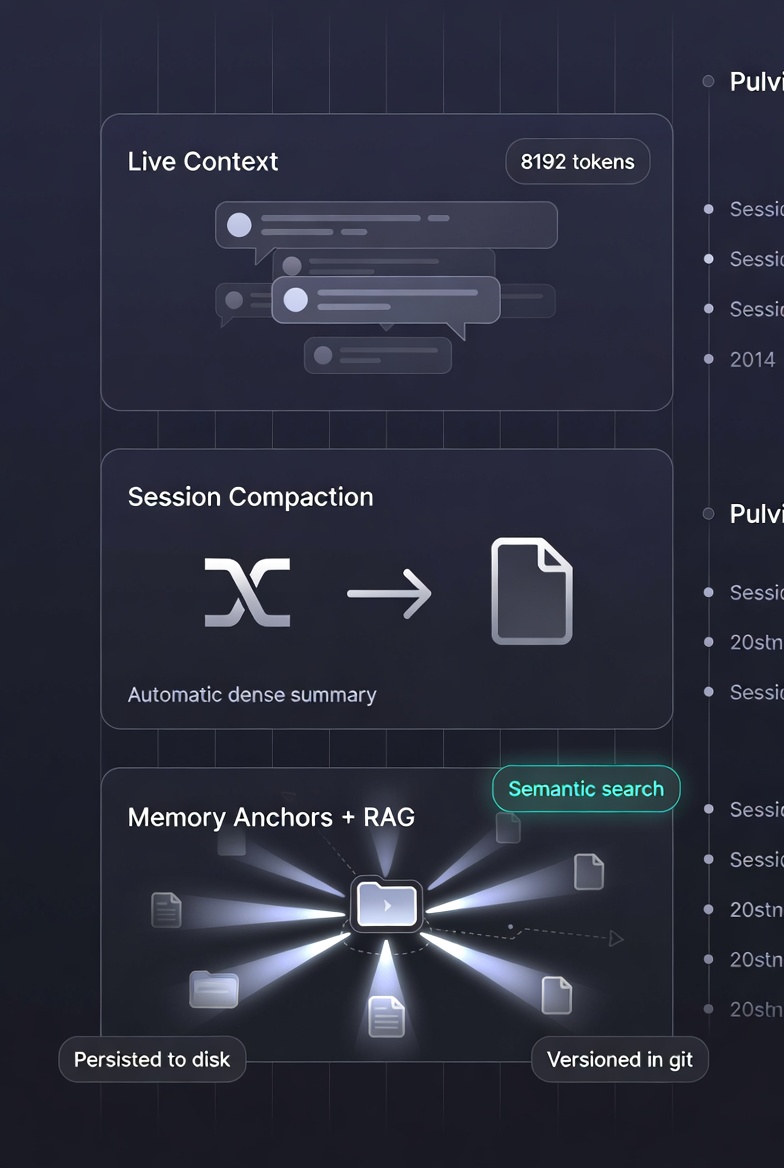
Voical's three-layer memory system gives the agent coherent long-term intelligence without ever exceeding the context window.
Live Context — The active conversation window (gated by available RAM: 8192 tokens on M4-class machines).
Session Compaction — When the context approaches capacity, Voical automatically (or manually) compresses the conversation into a dense, natural-language summary using a general-purpose model. The summary is treated as ground truth in the next session and is persisted to disk so it survives restarts.
Memory Anchors + RAG — Every compressed session and
manually saved note becomes a versioned "anchor" in
~/voical-memory/.
A live semantic index (plus a historical "Pulvinar" index that reaches
back through git) lets the agent retrieve relevant context from weeks
or months earlier.
Smart chunking, cosine relevance thresholds, incremental indexing, and an anchor eviction policy keep the system fast and sustainable even after hundreds of sessions.
The result is an AI that feels like it actually knows you — not just within one chat, but across time.
Voice cloning, the proactive agent, document writing, and code assistance all work offline. The mesh and memory systems continue to evolve locally.
Your data never leaves your trusted devices by default.
Every node has an Ed25519 keypair. All messages and results are double-signed.
Dangerous tools and internet actions require user approval with configurable levels — ask always, session, or safe-only.
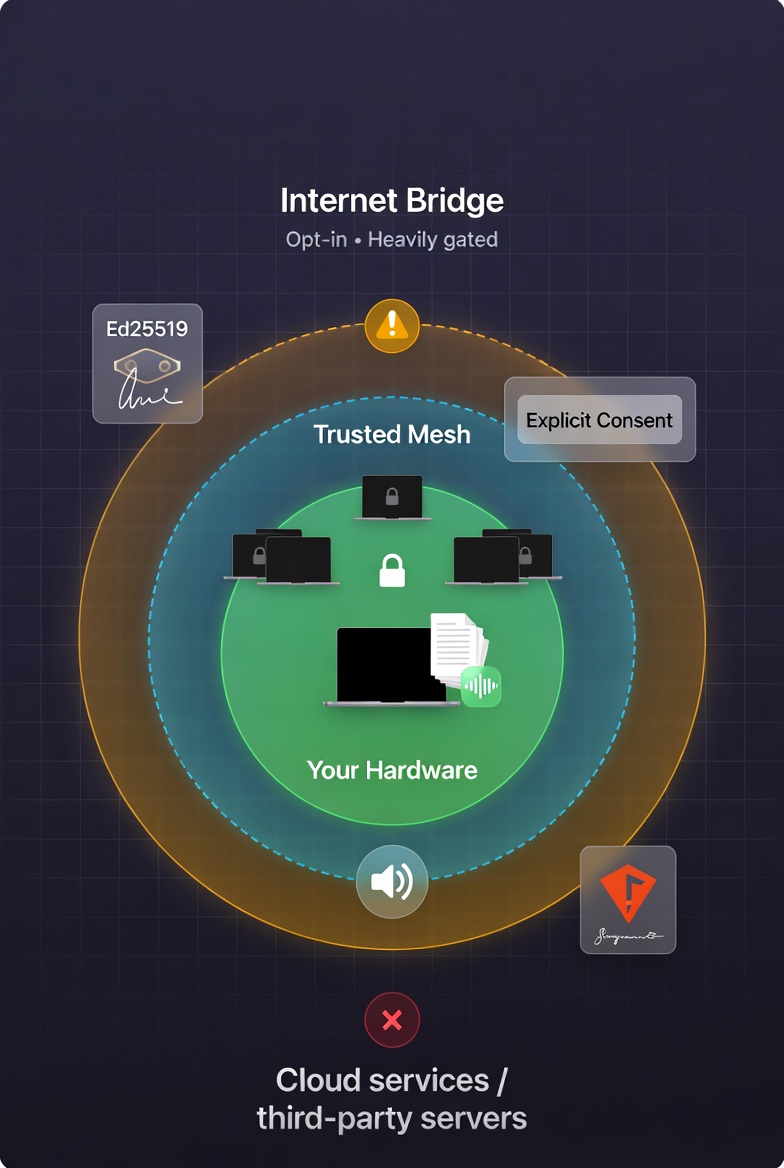
Voical's strict trust boundary. Data stays inside your trusted hardware by default.
There is no central server, no telemetry, and no ability for us to revoke access.
Those models are still stronger on certain creative and reasoning tasks.
What we are better at is ownership, privacy, speed on your hardware, long-term memory, and multi-device collaboration.
Current roadmap priorities include:
AI is becoming one of the most powerful tools humanity has ever built. The question is no longer whether it will be transformative — the question is who will control it.
Will your intelligence be rented from corporations that can change the rules at any time?
Or will it belong to you — running on hardware you already own, under rules you set, with data that never leaves your desk?
Voical exists so the answer can be the second one.
 Voical